

Crystal Bracelet Guides
How to Read a BaZi Chart: A Beginner’s Guide to the Four Pillars


A clear introduction to Chinese astrology, the Four Pillars, and the eight characters behind a BaZi chart.
| Quick answer: A BaZi chart is a traditional Chinese astrology chart built from a person’s birth year, month, day, and hour. Each time unit forms one pillar. Together, the four pillars create eight characters that readers use as a framework for reflection and interpretation. |
Chinese astrology can feel complex at first. A BaZi chart gives you a clean place to start.
BaZi means “eight characters.” It is also called the Four Pillars of Destiny. The system uses the year, month, day, and hour of birth to create four paired markers.
The Hong Kong Observatory explains that the Chinese stem-branch system combines 10 Heavenly Stems with 12 Earthly Branches. Those pairs form a 60-part cycle. The year, month, day, and hour together create the eight characters used in BaZi.
The Four Pillars in a BaZi chart
Each pillar has two parts: a Heavenly Stem and an Earthly Branch. You do not need to memorize every symbol on day one. Start by understanding the layout.
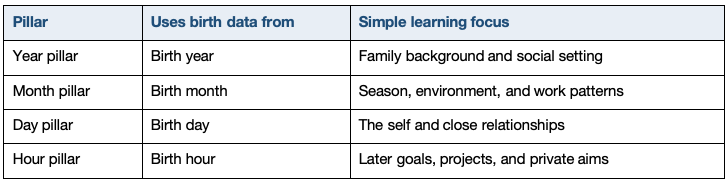
Traditional readers may use these pillars in different ways. Interpretations also vary by school and practitioner.
A simple BaZi chart flow
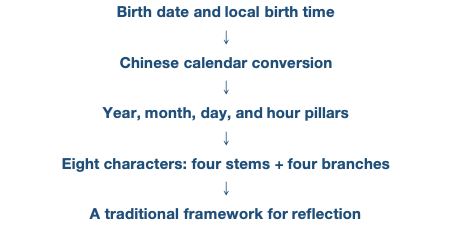
A BaZi chart works more like a map than a verdict. It gives people a language for patterns, balance, and timing. It does not remove personal choice.
Why accurate birth time matters
The birth hour changes the fourth pillar. In traditional Chinese timekeeping, a day is split into 12 two-hour periods.
That detail matters if you want a full BaZi chart. A missing or incorrect birth time does not make the chart useless, but it leaves out one layer.
Start with the best record you can find. Check a birth certificate, family record, or hospital record when possible. If the time is uncertain, label it as uncertain instead of guessing.
A simple example
Imagine that Maya was born on a specific date at 9:20 a.m. in Chicago. A BaZi calculator first converts that local time into the calendar system it uses.
The tool then produces four pillars. Maya sees a year pillar, month pillar, day pillar, and hour pillar. That output becomes her BaZi chart.
At this stage, do not jump to a dramatic conclusion. Start with basic questions:
Which elements appear more than once?
Which elements appear less often?
Which pillar feels most confusing?
What parts of the reading match your lived experience?
This approach keeps the process useful. It also prevents a chart from becoming a fixed label.
What the Chinese zodiac adds
Many people know their Chinese zodiac animal first. The 12-year animal cycle connects each animal with an Earthly Branch. Your zodiac animal is only one part of a BaZi chart.

What a BaZi chart cannot do
A BaZi chart does not prove that your future is fixed. It should not replace medical, legal, financial, or mental health advice.
Use it as a cultural tradition and a prompt for self-reflection. Keep your judgment, values, and real-world facts in the driver’s seat.
How to start reading your BaZi chart
Collect your birth date, location, and best-known birth time.
Generate your chart with a transparent tool.
Learn the four pillars before studying advanced rules.
Treat each interpretation as a question to explore, not a command to follow.
Explore a BaZi chart: https://yourdomain.com/bazi-calculator
Frequently asked questions
What does BaZi mean?
BaZi means “eight characters.” A BaZi chart uses four birth-time pillars, and each pillar contains a Heavenly Stem and an Earthly Branch. The four pairs create eight characters used in a traditional Chinese astrology framework.
Is a BaZi chart the same as the Chinese zodiac?
No. Your Chinese zodiac animal comes from your birth year. A BaZi chart also uses your birth month, day, and hour. It gives a more detailed traditional layout.
Do I need my exact birth time for a BaZi chart?
Your exact birth time improves the chart because it sets the hour pillar. If you do not know it, you can still explore the first three pillars. Be open about the missing detail.
Final thought
A BaZi chart is best understood as a traditional system for reading time, symbols, and personal patterns. Learn its structure first. Then decide what meaning, if any, it adds to your own reflection.
Educational note: This article discusses a cultural and spiritual tradition. It does not offer guaranteed predictions or professional advice.
Practical questions to ask before ordering
A useful article should help a reader make a decision, not only describe a mood. Before ordering, check the exact bead diameter, approximate wrist size, closure or elastic construction, finish, and expected natural variation. If the page is about a gift, confirm the occasion and the recipient’s existing style. If it is about personal intention, decide whether the bracelet will be worn daily, layered occasionally, or kept for a specific ritual. These details affect the best material and proportion more than a dramatic description alone.
Ask how the bracelet should be stored, whether water and chemicals should be avoided, and what to do if elastic becomes loose. A responsible maker should explain that natural stones can show differences from photographs. Those differences can include lighter or darker areas, inclusions, banding, cloudy sections, tiny surface marks, and variations in polish. Such details are part of natural material character. They should be described clearly so the customer knows what to expect.
How to make the design feel intentional
Start with one visual anchor. This may be a focal stone, a repeated color, a metal accent, or a contrast between light and dark beads. Add supporting materials only when they improve the overall rhythm. Too many competing colors can make a bracelet look accidental, while one thoughtful contrast can make the design feel complete. Consider the wearer’s skin tone, wardrobe, watch, rings, and whether they prefer quiet jewelry or expressive stacks.
For a custom order, prepare a short brief with the wearer, wrist measurement, bead size, main color, secondary colors, occasion, intention, budget, and preferred finish. Reference images are useful for mood, but they should not be treated as a promise of an identical copy. A handmade design translates the reference into available natural materials and a comfortable arrangement. Reviewing the brief before production reduces misunderstandings and creates a more transparent experience.
Everyday styling and care
Wear the bracelet where it can be seen without being exposed to unnecessary friction. Leave space between it and a watch or harder metal edge. Roll elastic jewelry gently over the hand rather than pulling one section repeatedly. Remove it before swimming, showering, intense exercise, sleeping, or household cleaning. Wipe the beads with a soft dry cloth and store the piece separately in a pouch or lined box.
Rotate jewelry instead of wearing one elastic strand through every activity. Check for gaps, fraying, weak tension, chipped beads, or a clasp that no longer closes securely. Early inspection can prevent a break and protects the small design decisions that make a handmade bracelet feel personal. If repair or restringing is needed, stop stretching the piece and seek maker or jeweler guidance.
Symbolism without exaggerated promises
Crystal and zodiac symbolism can be meaningful when it is presented as a personal language. A color can remind someone to pause. A birthstone can mark a birthday. A chakra palette can represent a personal reflection practice. A dark stone can become a reminder of boundaries, while a pink or green palette can recall care and connection. None of these associations should be presented as a guaranteed treatment, financial result, or prediction.
The most trustworthy description separates material facts from personal interpretation. Material facts include color, texture, bead size, finish, construction, and care. Interpretation belongs to the wearer and may change over time. This approach respects both the natural stone and the customer’s ability to decide what the bracelet means.
Final buying checklist
- Does the primary color suit the wearer’s wardrobe?
- Is the wrist measurement accurate and comfortable?
- Is the bead size appropriate for daily movement?
- Are natural variations and care needs explained?
- Does the bracelet have a clear construction and finishing description?
- Is the symbolism framed as personal meaning rather than certainty?
- Are the return, delivery, and support details easy to find?
- Would the wearer actually choose to put it on tomorrow?
A meaningful crystal bracelet is ultimately a relationship between material, design, and daily life. Let the stone provide character, let the color carry a story, and let the fit determine whether the piece becomes part of a real routine. Audday’s handmade approach begins with that practical balance and leaves room for the wearer’s own interpretation.